How to choose the right sandblasting cabin
Suction or pressure blasting, air consumption and the question of which parts you want to blast: what to look for when buying a sandblasting cabin.

Do not look only at the price. The right sandblasting cabin depends on what you blast, how often and how fast. These points will help you decide. You can find all models on our page about sandblasting cabins.
Suction or pressure blasting?


Suction (injector) blasting: the abrasive is drawn in from the collecting hopper and fed into the air stream in the blast gun. The amount of abrasive cannot be adjusted continuously. Suction cabins are cheaper and can still be very powerful, even in continuous operation. At SAPI, these are the Widder, Elch and Büffel models (suction cabins in the shop).
Pressure blasting: the abrasive comes from a pressure vessel that is fixed to the cabin hopper or stands next to the cabin. The amount of abrasive and the blasting pressure can be adjusted continuously. Pressure blasting is about 5 to 10 times more powerful than suction blasting, but needs more compressed air. At SAPI, this is the MM 2010.
Both in one cabin: the T-REX combines pressure and suction blasting (T-REX 100, T-REX 140).
Air consumption
- Suction
- 300 to 1,000 l/min
- Pressure
- 1,000 to 3,000 l/min
Check the actual delivery rate of your existing compressor before you decide. The compressor calculator helps with sizing.
What do you want to blast?
Steel parts with stubborn rust, several layers of paint or hard coatings such as powder coating? Then a pressure blasting cabin is the right choice. If you only remove rust or paint occasionally and time is not critical, a suction cabin with a suitable compressor is usually enough. Glass bead blasting is also mostly done in suction systems.
The right reusable abrasive is just as important. More on this in our guide Which abrasive do I need?
Size
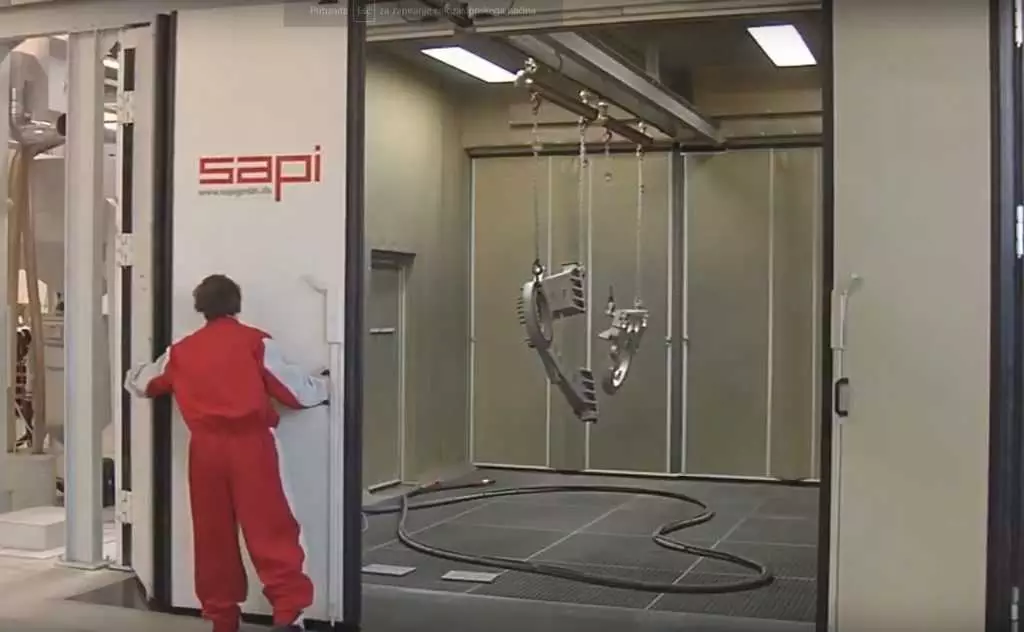
Choose the cabin size according to the largest components you want to blast, and think about future parts: experience shows that blasting work increases once a cabin is in-house. For bar material or parts that exceed the cabin dimensions, side pass-through openings are useful. For very large parts, there is the walk-in JUMBO blast cabin.
Extraction system

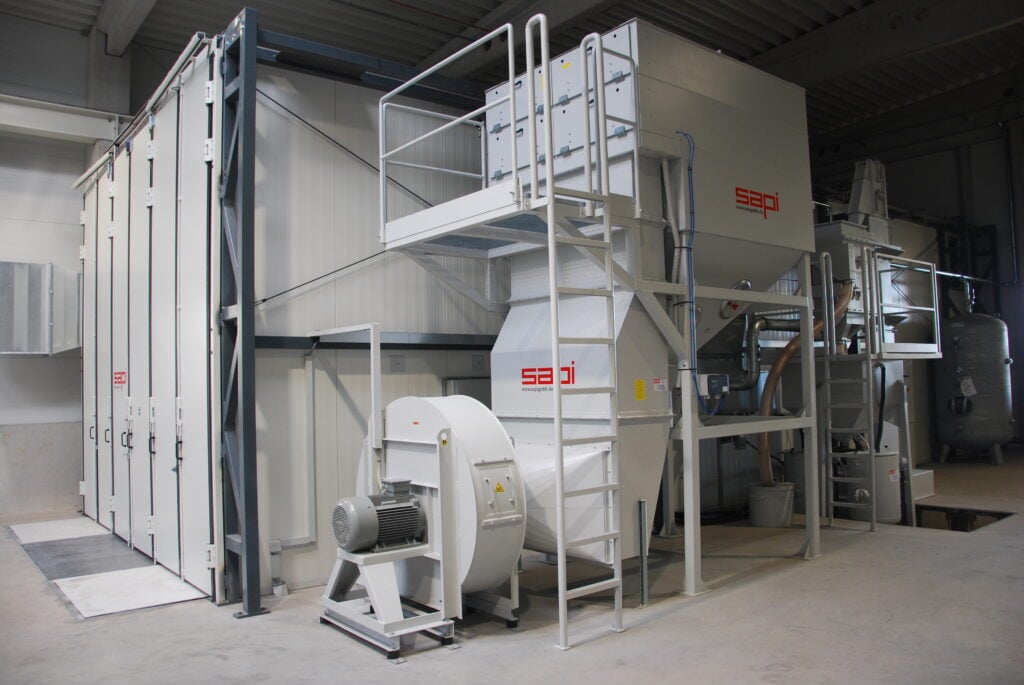
The extraction must suit the application. If it is too small, there is dust inside and outside the cabin. If it is too large, abrasive that is still usable ends up in the dust container. For smaller suction cabins used irregularly, a bag filter is sometimes enough. For frequent use and for pressure blasting cabins, a matched cartridge filter is required. With automatic cleaning, it can be integrated at the back of the cabin to save space (extraction systems in the shop).
Doors and loading
If you want to load from the front or with a forklift, choose a model with a large front flap. Alternatively, there are cabins with side doors.
Accessories and lighting
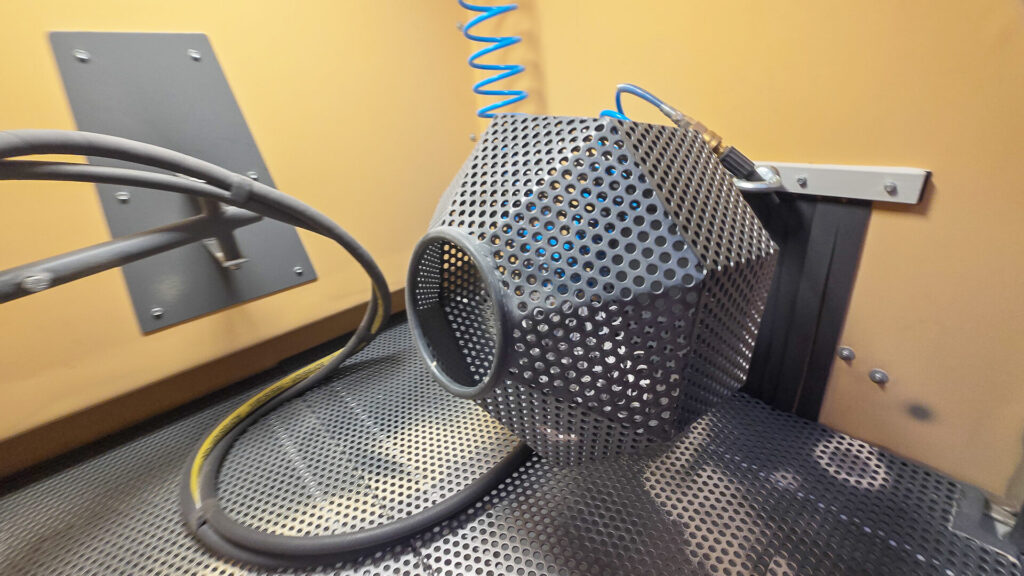
Accessories make the work easier: a swivel arm with nozzle holder, manual or automatic turntables, or a rotating basket for small bulk parts, controlled via the SAPI OS touch display. Also make sure there is enough light. SAPI fits energy-saving, glare-free LED lights in the cabin roof.
Construction and maintenance
SAPI manufactures all cabins to current standards in a sturdy sheet steel construction with a light-coloured, fabric-reinforced rubber lining. We only use boron carbide blast nozzles with a service life of around 800 to 1,000 blasting hours. Safe operation also requires the annual UVV safety inspection.