Planning a sandblasting hall: 7 questions before you request a quotation
Size, loading, filter, abrasive recovery, abrasive, location and standards: with these seven questions, your enquiry for a sandblasting hall is quick and precise.
A sandblasting hall is an investment for many years. The clearer the requirements, the more accurate the quotation. You should answer these seven questions beforehand.
1. Which workpieces do you blast?
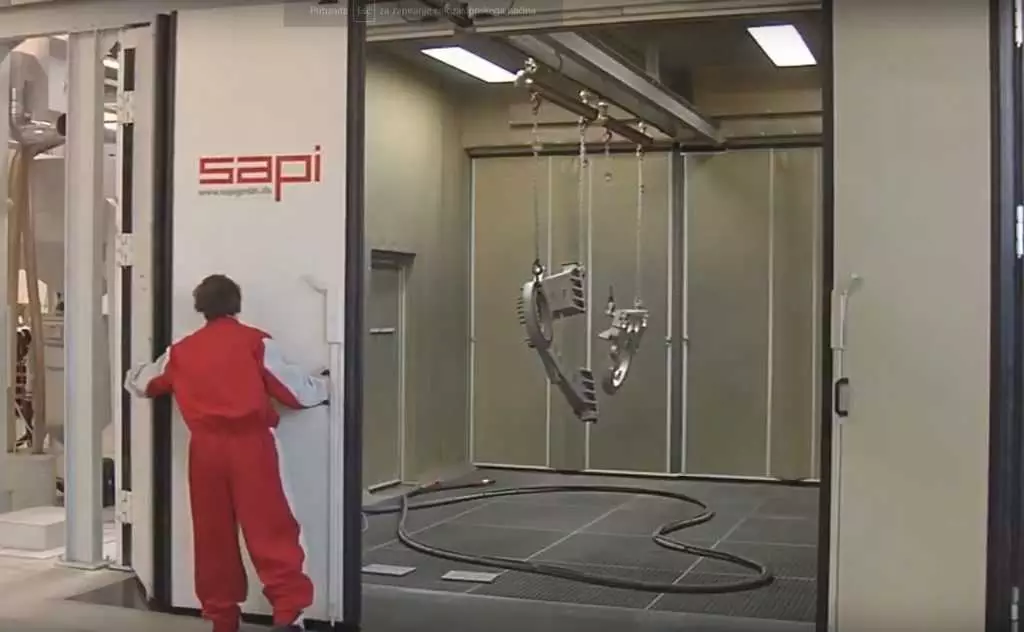
The dimensions, weight and quantity of the largest workpiece determine the size of the hall. SAPI builds halls 3 to 100 m long, 2 to 20 m wide and 2.5 to 15 m high. Plan for working space around the component.
2. How does the workpiece get into the hall?
By transport cart, rail system or forklift, through a double-leaf, four-leaf or sliding door. For heavy parts, a crane can work from above: crane runway openings and ceiling openings can be integrated into the roof, as in our hall with a sliding roof.
3. Which filter system do you need?
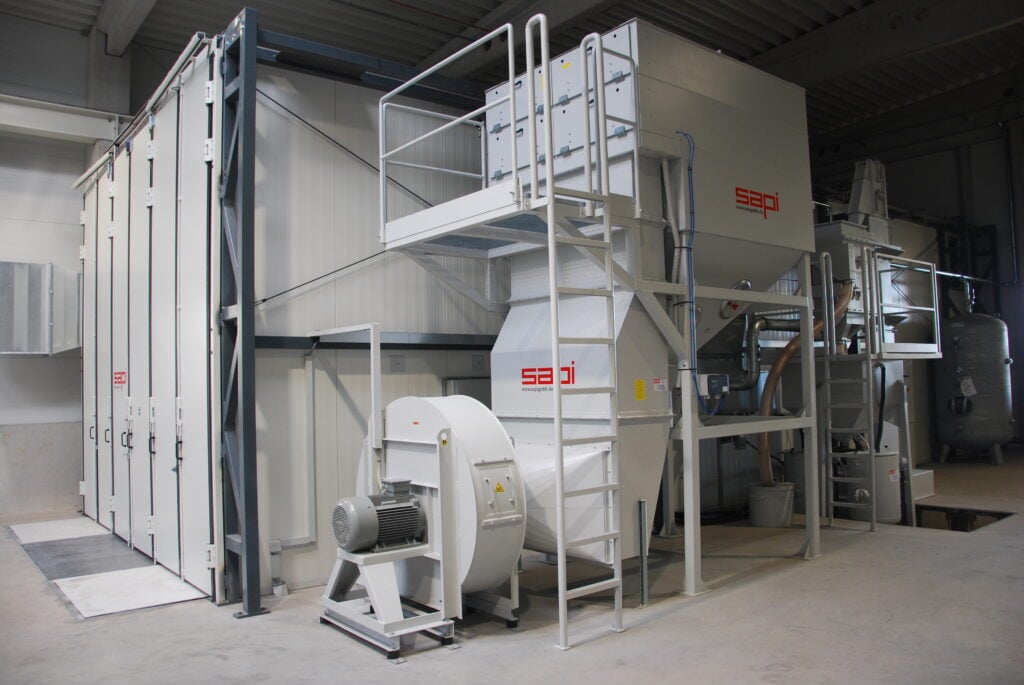
The filter system is matched to the hall volume. Cartridge filters are available in modules from 900 to 9,000 m³/h for small and medium-sized halls, and high-performance filters from 15,000 to over 40,000 m³/h for large halls and multi-operator use. Part of the cleaned air can be recirculated to save heating energy.
4. How should the abrasive come back?
From fully automatic via longitudinal and cross conveyors to manual sweeping. More on this in our guide to abrasive recovery.
5. Which abrasive do you work with?
All dry, fine-grained mineral abrasives can be used in SAPI halls, such as fused alumina, glass beads or steel grit. The abrasive affects the conveyors, separator and filter, so it belongs in the planning.
6. What is available on site?
You need compressed air, power (400 V / 50 Hz), a level, load-bearing concrete floor and adequately sized supply lines. For outdoor installation, weather protection is needed during installation. SAPI provides detailed site preparation guidelines in advance.
7. Which standards apply?
SAPI sandblasting halls comply with the Machinery Directive 2006/42/EC. With combustible dusts such as aluminium or magnesium, ATEX (Directive 2014/34/EU) also applies. Also state the required degree of cleanliness, for example Sa 2½ or Sa 3 according to ISO 8501-1.
Good to know
- Installation
- CORE halls usually 2–3 weeks, custom halls 3–12 weeks
- Warranty
- 12 months from delivery for single-shift operation, under VDMA conditions
- Fast route
- preconfigured CORE sandblasting hall in three sizes
With these answers, we can design your sandblasting hall precisely.