


The „VARIO“ low pres-sure mild blasting clean-ing technique is a modi-fied material conserving blasting procedure work-ing with very low air pres-sures from 0,1 – 3.0 bar and is equipped with an especially conserving „VARIO“ – Vortex stream nozzle. The VARIO Vortex stream nozzle, an important component of the low pressure blasting technique, has in the casing a particular Vortex stream body which puts the pressure air stream alike a cyclone into high rotation. The blasting particles are finely distributed in the rotating air stream are drawn with a very smooth impact pressure rotatingly over the surface to be cleaned. Thus a fine grinding, erasing cleaning effect is achieved, which conserves uniquely the surface texture to be cleaned. A range of mild blasting materials, such as glass powder, calcite powder, stone powder and other special blasting materials are at disposal for the mild cleaning of the different building materials. In every case where the most conserv-ing material and surface treatment is the matter,as for example the removal of graffitis, the VARIO Vortex stream nozzle de-monstrates decisive ad-vantages compared to the conventional blasting nozzle technique.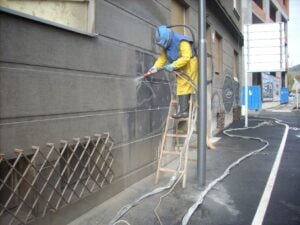
The removal of the graffitis can alternatively be carried out in dry or wet process whereas in the wet process only 10 – 30 l water per hour are used to prevent extensively the dust formation. The conserving cleaning method can be demonstrated clearly for example by removing from a newspaper the printed letters without damaging the paper.
Depending on the type of underground to be cleaned, as for example natural stone, brick, mineral plaster, ceramic glazed and unglazed, glass up to NE-metals such as bronze, different mild blasting materials with appropriate fine grain sizes and degrees of hardness are applied – The more sensible the underground the finer the blasting material has to be.
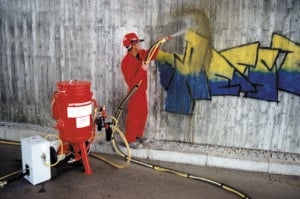 Of course, the degree of hardness of the blasting material is also important, especially with polished natural stone surfaces such as granite, marble as well as ceramic, glass and brick surfaces where primarily crystalline dolo-mite or calcite powder with approximately 3.5 – 4.0 Moh’s hardness and a grain size up to 250 µm come into operation. In the case of lesser sensitive surfaces such as unpolished natural stone glass powder (melting chamber slag) with approximately 6.0 – 6,5 Moh’s hardness up to a grain size of 40 – 250 µm is particularly well suited. Need less to say that there is a range of other suitable mineral and organic blasting materials qualified also for the removal of graffitis which have not to be especially mentioned in this context. Basically it is recom-mended before carrying out the cleaning procedure to create a test area to determine the necessary cleaning para-meter for the cleaning task.