
Vacuum-recovery blasters · dust-free sandblasting
Vacuum sandblasters. Blasting without a dust cloud.
With a vacuum-recovery blaster you can blast where normal sandblasting is impossible or prohibited: indoors, in the workshop or next to ongoing operations. A brush on the blast head seals against the surface, and abrasive and dust are sucked back immediately.
Made in Germany · since 1970
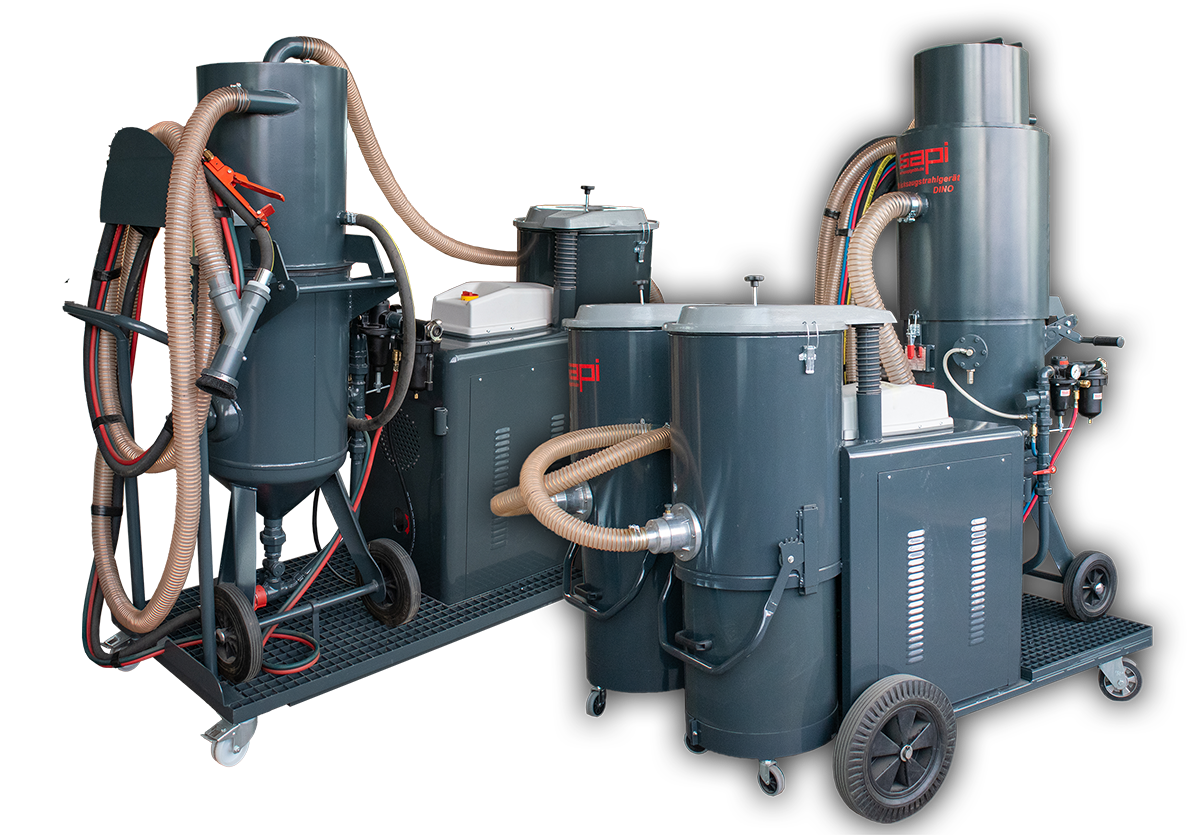
- Dust-freeBlasting without masking or a dust cloud
- Indoors & outdoorseven where sandblasting is otherwise prohibited
- 3 modelsPR 50, DINO II, DINO MASTER
- up to 10 m²/hblasting output depending on model
Principle
How vacuum-recovery blasting works
A vacuum-recovery blaster combines sandblasting with a vacuum system. Everything that rebounds during blasting is captured right at the blast head.
- 1
Seal
A dust-capture brush surrounds the nozzle and rests on the surface, so no dust can escape from the blasting area.
- 2
Blast
The abrasive hits the surface and removes rust, paint or dirt.
- 3
Extract
Abrasive, dust and removed material are extracted immediately through the recovery hose.
- 4
Separate and reuse
In the cyclone, good abrasive separates from dust and dirt and goes back into the cycle. The dust ends up in the filter or vacuum.

Models
Three vacuum-recovery blasters for every job
From the handy injector machine for the workshop to the pressure vacuum-recovery machine for long welds and large areas.

Injector vacuum-recovery blaster
PR 50
Compact and economical: ideal for occasional work on smaller parts, welds, rust spots and car bodies. Runs on little compressed air and from a standard socket.
- 50 L silo (unpressurised)
- 1–4 m²/h

Pressure vacuum-recovery machine, 60 L
DINO II
Blasts like a pressure blasting machine, only without the dust cloud. Faster than injector technology, for longer welds and larger areas, even with heavy metallic abrasives.
- 60 L pressure vessel
- 3–8 m²/h

Pressure vacuum-recovery machine, 100 L
DINO MASTER
The largest model: 100 litres of abrasive for longer work without refilling, with double dust and waste containers on a heavy-duty trolley.
- 100 L pressure vessel
- 3–10 m²/h
| PR 50 | DINO II | DINO MASTER | |
|---|---|---|---|
| Principle | Injector | Pressure | Pressure |
| Abrasive container | 50 L silo (unpressurised) | 60 L pressure vessel | 100 L pressure vessel |
| Working pressure | 3–12 bar | 1–6 bar | on request |
| Air consumption | 400–800 l/min | from approx. 1.500 l/min | from approx. 3.000 l/min |
| Blasting output | 1–4 m²/h | 3–8 m²/h | 3–10 m²/h |
| Extraction | TURBO vacuum, 230 V | Extraction unit 5.5 kW, 400 V | Extraction unit, double dust container |
| Weight | approx. 38 kg | approx. 295 kg | on request |
Blasting output depends on the surface, compressor and abrasive.
How it works
PR 50 and DINO in cross-section
Press the lever, change the pressure and follow the path of abrasive and dust.
Simplified illustration: The animations only explain the working principle. They do not show the machines to scale, and the values and sequences displayed are not measured. The technical data of each machine is what counts.
Schematic illustration for explanation, not measured values.
PR 50 injector vacuum-recovery blaster: dust-free with cyclone and vacuum
The PR 50 works on the injector principle: the abrasive sits unpressurised in the silo. The blast gun rests on the surface with a dust-capture brush, and whatever rebounds is sucked straight back. The machine consists of three separable parts: silo, cyclone and vacuum. The cyclone does the separating: reusable abrasive falls through the screen back into the silo, while the TURBO vacuum draws off dust and dirt.
- Compressed airRuns through the handle straight into the blast gun. 400 to 800 l/min is enough.
- Silo (unpressurised)50 litres of supply. The container is not under pressure.
- Blast hoseSuction pulls the abrasive into the blast head.
- Blast gun with dust-capture brushTrigger in the hand, round brush on the surface. Brushes for flat surfaces and for inside and outside corners are available.
- Recovery hoseExtracts abrasive and dust right at the brush.
- Recovery cycloneA separate component between silo and vacuum, secured with clamps. This is where the abrasive separates from dust and dirt.
- ScreenA perforated disc at the bottom of the cyclone: it holds back coarse debris, and good abrasive falls into the silo below.
- TURBO vacuumIndustrial vacuum with polyester/cotton filter: draws dust and dirt out of the top of the cyclone.
- 230 V power connectionThe TURBO vacuum runs from a standard socket.
- Blast
- Vessel
- Rubber cone
- Extraction
- running, switched off separately
Schematic illustration for explanation, not measured values.
DINO pressure vacuum-recovery machine: pressure blasting without a dust cloud
The DINO blasts from the pressure vessel just like a normal pressure blasting machine. At the front of the nozzle there is also an attachment with brushes that seals the blast against the surface. Abrasive and dust are drawn into the cyclone on top of the vessel. Good abrasive collects there and, when you release the lever, falls back into the vessel as soon as the rubber cone drops. Dust and fines leave the top of the cyclone for the large 5.5 kW extraction unit. There a filter cartridge cleans the air and the dust falls into the container below.
- Compressed airPressurises the vessel and accelerates the abrasive.
- Pressure vesselConventional pressure blasting: 60 litres, 1 to 6 bar, from approx. 1,500 l/min.
- Blast hoseCarries the mixture from the vessel to the nozzle.
- Nozzle in PVC Y-pieceThe nozzle sits in the grey PVC Y-piece, with the round dust-capture brush at the front. The recovery hose connects at the angled branch.
- Recovery hoseSucks abrasive and dust back, including heavy metallic abrasives.
- Recovery cycloneSits on the vessel and returns good abrasive straight to the cycle.
- 5.5 kW extraction unitCreates the suction. The connection leaves from the top of the cyclone.
- Cartridge filter with shaker leverA filter cartridge cleans the air. Use the hand lever on top to shake the dust off.
- Dust containerSits beneath the filter and can be removed completely for emptying.
- Three-phase connectionThe extraction unit runs on 3 phases: 400 V, 50 Hz, 32 A CEE plug.
- Deadman leverPressing the lever starts blasting, and releasing it stops it at once.
- Inlet/outlet valveOn release the outlet opens and the pressure escapes downwards through the silencer, which dampens the noise. On pressing, it closes and the vessel builds pressure again.
- Rubber coneUnder pressure it seals the opening to the cyclone. Without pressure it drops, and the collected abrasive falls into the vessel.
Applications
Where dust-free sandblasting is needed
Workshops and indoor spaces
Blasting without masking and without dust in the hall, even next to other workstations.
Welds
Clean welds and edges precisely before inspection or coating.
Automotive and bodywork
Remove rust spots and old coatings from body parts with pinpoint accuracy.
Steel construction, shipbuilding, oil and gas
Touch-up and preparation of steel surfaces during maintenance and repair.
Construction and maintenance
Work on buildings, plants and components where open blasting is not allowed.
Stone and glass
At low pressure, even delicate surfaces such as natural stone or glass can be treated.
Your benefits
- Clean working environment, hardly any cleaning effort
- Low abrasive consumption thanks to recycling
- Lower disposal costs
- Protection for operators and surroundings
- Easy to use, even for beginners
Scope of supply
Delivered complete and ready to use
Usually included in the offer
- Blast hose
- Nozzle
- Pressure regulator
- Water separator
- Abrasive metering valve
- Basic personal protective equipment
Good to know
- Compressed airPR 50: 400–800 l/min. DINO II: from approx. 1.500 l/min. DINO MASTER: from approx. 3.000 l/min.
- PowerPR 50: standard 230 V socket. DINO: three-phase 400 V, 50 Hz, 32-A-CEE plug.
- BrushesBrush attachments for flat surfaces and for inside and outside corners.
- TransportThe PR 50 consists of three separable parts. The DINO models stand on a heavy-duty trolley.
Videos
Dust-free blasting in action
Frequently asked questions
Questions about vacuum-recovery blasting
What is a vacuum-recovery blaster?
A vacuum sandblaster: a brush on the blast head seals against the surface, and abrasive and dust are sucked back immediately. In the cyclone, good abrasive is separated and reused, while the dust is filtered.
Can I sandblast indoors?
Yes. Vacuum-recovery blasters are built for exactly that: for workshops, halls and anywhere normal sandblasting is impossible or prohibited.
PR 50 or DINO: which machine is right for me?
The PR 50 works on the injector principle and is designed for occasional work on smaller parts, welds and rust spots. The DINO models work with pressure, are faster and suit longer welds and larger areas.
How much compressed air do I need?
The PR 50 manages with 400 to 800 l/min. The DINO II needs from approx. 1,500 l/min, the DINO MASTER from approx. 3,000 l/min.
What power supply do I need?
The TURBO vacuum of the PR 50 runs from a standard 230 V socket. The extraction unit of the DINO models needs three-phase power: 400 V, 50 Hz, 32-A-CEE plug.
What blasting output can I expect?
Depending on the surface, compressor and abrasive, about 1 to 4 m² per hour with the PR 50, 3 to 8 m² with the DINO II and 3 to 10 m² with the DINO MASTER.
Can I reach corners and edges?
Yes. In addition to the round brush for flat surfaces, there are brush attachments for inside and outside corners.
Which abrasives can I use?
That depends on the machine and the task. The DINO models also recover heavy metallic abrasives. We will be happy to advise you on the right abrasive.
What is included in the scope of supply?
The machines are delivered complete and ready to use. Our offer usually includes blast hose, nozzle, pressure regulator, water separator, abrasive metering valve and basic protective equipment.
Prefer a classic sandblaster after all?
Compare pressure blasters, injector blasters and fine blasters, with machine finder and air consumption calculator.