
SAPI sandblasting cabins
The right sandblasting cabin for every workshop
Injector, pressure or both in one cabin: from the compact Widder 70 to the MM 2010 with automatic abrasive recycling. Standard models, practical add-ons and custom builds tailored to your requirements.

- since 1970Manufacturer of blasting technology
- TÜV & CEtested and compliant
- up to 99 %dust-free working
- custom-builtSpecial cabins & modifications
Three blasting systems – it all depends on the application
How the abrasive reaches the nozzle determines the cabin's performance, speed and price.
Injector sandblasting cabins
An air-driven venturi system creates a vacuum that draws the abrasive up to the nozzle, where it is carried by the air stream onto the workpiece. Economical, easy to operate and low-maintenance – ideal for lighter work.
- Low purchase cost
- Easy to operate
- Minimal maintenance
Widder · Elch · Büffel
See the modelsT-REX: injector + pressure
The T-REX combines both methods in one cabin. A hand switch lets you change between injector and pressure blasting at any time – optionally with an integrated filter system as an all-in-one solution.
- Two methods in one cabin
- Switch over by hand switch
- Integrated filter available
T-REX 100 · T-REX 140
See the modelsPressure sandblasting cabins
A pressure vessel forces the air and abrasive mixture through the blast hose together. The result: many times more blasting power for large surfaces, tough coatings and high throughput.
- Much faster blasting
- For heavy-duty work
- Automatic recycling (MM 2010)
MM 2010 · T-REX 100 · T-REX 140
See the modelsOur models
Dimensions in mm (height × width × depth). All cabins are available with add-ons and as custom versions.
-
 Injector
Widder 70 / 100
Compact injector cabin for small to medium-sized parts – rugged and reliable, ideal for metalworking and workshops.
H × W × D Widder 70 600 × 700 × 600 Widder 100 600 × 1,000 × 600 - Side door on the right
- Suitable for various abrasives
- External filter system required
-
Injector
Elch 100 / 130
Versatile injector cabin for medium-sized to large parts, with a large viewing window for good control of the blasting process.
H × W × D Elch 100 750 × 1,000 × 700 Elch 130 750 × 1,300 × 850 - Large viewing window
- 2 side doors
- External filter system required
-
Injector
Büffel 140 / 180
The large injector cabin for demanding applications, high throughput and heavy parts.
H × W × D Büffel 140 900 × 1,350 × 950 Büffel 180 900 × 1,750 × 1,400 - Front flap: loading by crane or forklift
- Optional integrated filter
- Built for high throughput
-
Combo
T-REX 100 / 140
Injector and pressure blasting in one compact cabin – perfect for workshops with varying tasks and limited space.
H × W × D T-REX 100 850 × 1,000 × 800 T-REX 140 850 × 1,350 × 1,000 - Injector/pressure via hand switch
- Integrated filter system
- LED lighting, side pass-through openings
-
 Pressure
MM 2010
Pressure sandblasting cabin with automatic abrasive recycling for fast turnaround without cleaning breaks – for medium-sized to large parts.
- SAPI Mammut pressure blaster with QUICK STOP™
- Elevator + flat conveyor: abrasive is cleaned and returned to the cycle
- 3 viewing windows, 4 glove ports
- Touch control panel, LED lighting on the left and right


Injector, pressure or combo?
It all comes down to what you blast and the result you need. A quick overview:
| Injector | Pressure | Combo (T-REX) | |
|---|---|---|---|
| Principle | Vacuum draws the abrasive to the nozzle | Pressure vessel forces air + abrasive through the hose together | Both – selectable via hand switch |
| Blasting power | For lighter work | Many times higher, much faster | Depending on mode |
| Ideal for | Occasional jobs, smaller and thinner parts, limited space and budget | Large surfaces, hard and thick coatings, continuous operation | Varying tasks in a small space |
| Investment | Lowest cost | Higher investment, pays off quickly with heavy use | Two cabins in one |
| Maintenance | Low | Somewhat higher (pressure vessel) | As for injector or pressure |
| Models | Widder, Elch, Büffel | MM 2010 | T-REX 100, T-REX 140 |
Add-ons and modifications
Make your cabin faster and more convenient: swivel arm, turntables, rotary tables, pass-through openings – and, new, the rotating basket for large batches of small parts.
-
 New
Rotating basket for small parts
Ideal for large batches of small parts such as screws, nuts or fittings. Load the parts into the basket, set the blasting time and rotation speed on the LCD touch display and press start – the basket rotates during blasting so every part is treated evenly from all sides. The basket is removable, so the cabin can still be used as a standard sandblasting cabin at any time.
-
Swivel arm with blast gun holder
The blast nozzle is clamped in the holder, leaving the operator both hands free to hold and turn the workpiece. Angle and inclination can be adjusted and locked.
Item no. 3841.280
-
Turntable ø 400 mm, manual
Easy to retrofit: the turntable simply sits on the cabin's existing work grating.
Item no. 9841.240
-
Rotary table ø 500 mm, manual
Makes it easier to work on heavy, awkward parts. Mobile and removable from the blast chamber when needed. Max. load capacity 40 kg.
Item no. 9841.250
-
Rotary table ø 600 mm, manual
For heavy, awkward parts. Mobile and removable from the blast chamber when needed. Max. load capacity 200 kg.
Item no. 9841.260
-
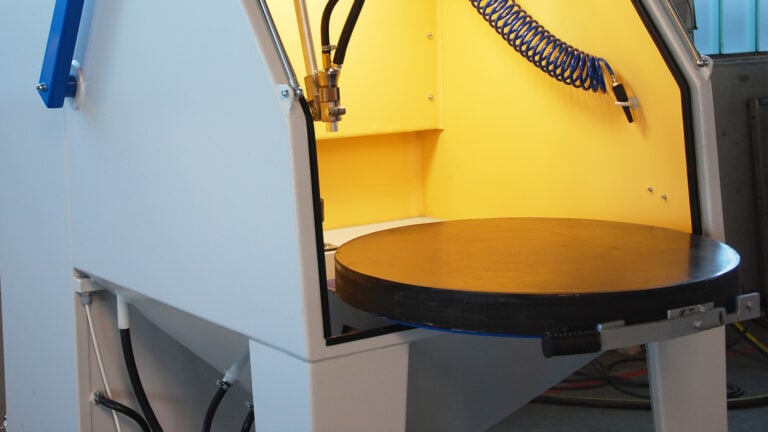
Rotary table ø 600 mm in the work grating
Permanently integrated into the work grid and manually operated – when not in use, it leaves a flat working surface. Max. load capacity 200 kg.
-
Permanently fitted rubber gloves
The gloves are attached directly to the cabin with a flange ring.
Item no. 3941.135
-
Pull-out turntable
Can be pulled roughly halfway out of the cabin – heavy parts are easily placed on it by crane or forklift.
-
Pull-out rotary table with trolley
The rotary table moves completely out of the cabin on a trolley with swivel castors, so you can load it freely by crane or forklift.
-
Pass-through openings
Side openings for long workpieces that are pushed through the cabin. Rubber curtains prevent abrasive from escaping.




Sandblasting cabins in action
See our cabins, add-ons and blast tests in action.
-
Touch LCD control for automatic and semi-automatic cabins
-
BÜFFEL 140 – turntable and nozzle oscillation
-
Blast test with corundum F24/F46 at 3/5 bar – T-REX 140
-
SAPI pressure blast cabin – detailed presentation
Custom builds to customer specification
If a standard model doesn't fit, we build the cabin around your parts and processes.
T-REX with pneumatic front flap
Special cabin with a front flap that opens and closes pneumatically at the push of a button – convenient, safe access without moving the flap by hand.
MM 4000 for two operators
For two operators working simultaneously: rail system inside and outside with a large pull-out table for heavy parts. Excess abrasive falls into the collection hoppers and is returned to the cycle by flat conveyor.
Injector cabin with 2 nozzles and automatic rotary table
For greater surface output: two adjustable nozzles and a rotary table recessed into the grating. Speed and duration are set via the SAPI touchscreen control.
Injector cabin with pull-out rotary table up to 300 kg
For very heavy parts: the manually rotated table moves out of the cabin on rails, is loaded by crane and pushed back in – for parts up to 300 kg.
Frequently asked questions
Which sandblasting cabin is right for me?
That depends on your application. To find the right cabin, we will go through the following with you:
- What do you want to blast?
- Which abrasive do you want to use?
- How much air does your compressor deliver?
- How many hours a day do you want to blast?
- Do you need an integrated or a separate filter system?
Give us a call – we will find the best cabin for you.
What is the difference between injector and pressure sandblasting cabins?
The main difference is speed and effectiveness.
In an injector cabin, the abrasive sits in the funnel-shaped bottom of the cabin. On start-up it is drawn by vacuum through a hose into the mixing chamber, where it meets the separate air stream and is accelerated through the nozzle onto the workpiece.
In a pressure sandblasting cabin, the abrasive falls into a pressure vessel beneath the cabin. During blasting the vessel closes and builds up pressure; the air and abrasive mixture is then conveyed together at high pressure through the blast hose to the nozzle.
Can I have injector and pressure blasting in one cabin?
Yes. With our T-REX series (T-REX 100 and T-REX 140), you can switch between injector and pressure blasting at any time using a hand switch. With an integrated filter system, the T-REX is an all-in-one solution.
Which filter do I need for my sandblasting cabin?
That depends on the cabin size, how often you blast and the abrasive used.
For a small cabin such as the Widder 70 with 1–2 hours of blasting per day and light abrasives such as corundum or glass beads, we recommend the Turbo II or Turbo III industrial vacuum.
For larger cabins such as the T-REX 140 running up to 8 hours a day, we recommend the PC 2 cartridge filter extraction unit. For 4–5 hours a day, the PC 1 cartridge filter or the TFA 1 / TFA 2 bag filter extraction is the best choice.
Just get in touch – together we will find the optimal solution. View filter systems
Can I use ordinary quartz sand as an abrasive?
No. A sandblasting cabin is a closed system with a filter unit. Quartz sand would fill the cabin with fine dust within seconds, obscure your view and clog the filter. Above all, it is a health hazard: quartz dust can cause silicosis, a serious lung disease. That is why blasting with quartz sand is banned in the EU.
How can I improve visibility inside the cabin?
Poor visibility usually has one of these causes:
- The filter system is too weak or clogged.
- The lighting is no longer sufficient.
- The abrasive is unsuitable, low-quality or too fine (e.g. very dusty slag).
- The rubber lining is worn.
If visibility deteriorates within seconds, the abrasive is usually to blame. If the cabin fills with dust after a few minutes, the filter is too weak or clogged. If the filter is working properly, modern LED lighting is worth the investment. Often overlooked: a new, light-yellow rubber lining reflects light – over time it becomes dull and visibility suffers.
What maintenance does a sandblasting cabin need?
The most important task is cleaning the filter system daily; our TFA 1/2 and PC 1/2 have built-in filter cleaning systems for this. Empty the collection container every day so that it does not overflow.
Cleaning the rubber lining regularly extends its service life and ensures good visibility. Also check the safety switches and the secure fit of the filter regularly, as vibrations can loosen bolted connections.
Is sandblasting in a cabin safe?
Yes. All SAPI cabins are TÜV-certified and CE-compliant and have all the necessary safety switches: if the door or front flap is not fully closed, blasting will not start – and if it is opened during blasting, the process stops immediately.
You work up to 99 % dust-free; on request, the exhaust air can also be ducted outside. Tip: after blasting, blow off the cabin and workpiece with compressed air while the filter is running, and let the filter run on for a few more minutes.

Sandblasting cabins catalogue
All models, dimensions and options at a glance as a PDF.
Download PDF catalogueNot sure which cabin is right for you?
Every application has its own requirements. Tell us what you want to blast – we will recommend the right cabin, abrasive and filter system.