Which abrasive do I need?
Brown fused alumina, white fused alumina, glass beads or cast steel: which reusable abrasive suits your blast cabin and your workpiece?

The right abrasive determines the result, the costs and the visibility in the cabin. A blast cabin with recovery therefore needs a reusable abrasive.
In short
- Roughening, rust removal
- Brown fused alumina or metallic abrasive (pressure blasting only)
- Stainless steel, aluminium
- White fused alumina
- Gentle, glossy
- Glass beads
- Not in the cabin
- Single-use abrasives such as slag; quartz sand is prohibited
Why single-use abrasives do not belong in the cabin
If a single-use abrasive such as slag (aluminium silicate) or quartz sand is used in the blast cabin, the working space fills up with fine dust in no time. You can no longer see where you are blasting. Incidentally, quartz sand is prohibited for blasting.
The recycling principle is lost as well: either almost all of the abrasive ends up in the extraction system after a short time, or it remains in the plant as fine dust because the extraction performance drops. The extraction is put under unnecessary strain, and wear parts such as filters, viewing window and seals wear out faster. Slag is intended for blasting work in which the abrasive is not recovered, such as open blasting.

The most important reusable abrasives
Brown fused alumina (brown/grey)

An almost iron-free abrasive that consists mostly of aluminium oxide. The very hard, angular grain roughens the surface and prepares it, for example, for a coating. Use: removing rust and paint from steel and cast parts.
Brown fused alumina in the shop
White fused alumina (white)

An iron-free abrasive made of high-purity aluminium oxide with the same blasting properties as brown fused alumina. Use: processing stainless steel and aluminium.
White fused alumina in the shop
Glass beads (white)
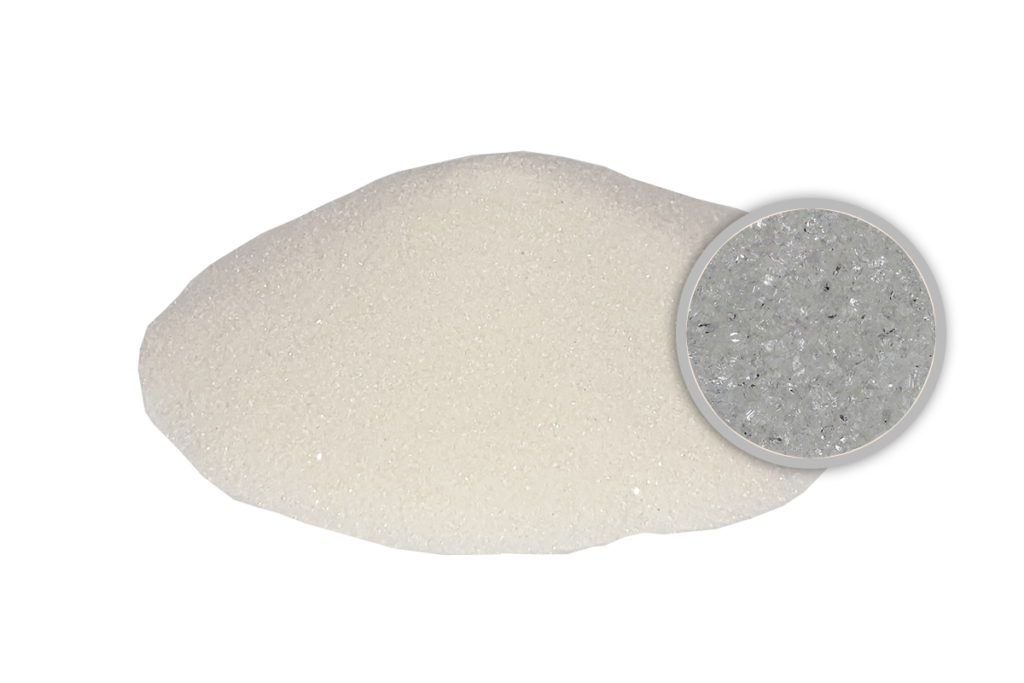
An iron-free abrasive for gentle processing. The round grain has a polishing effect: it cleans the surface and creates an even, partly glossy finish. Use: stainless steel and aluminium parts, as a finish or as preparation, for example for anodising. Glass bead blasting is mostly done in suction (injector) cabins.
Metallic, angular abrasive (chilled cast iron, cast steel)

Very abrasive and extremely durable compared with all other types. The component is roughened and prepared for subsequent coatings. Use: removing rust, paint and scale from metal parts. Because of its high bulk density, it is only suitable for the pressure blasting process, i.e. for pressure blasting cabins such as the MM 2010, not for suction (injector) systems.
Other abrasives
There are many other types for special applications, such as plastic abrasives, ceramic beads, garnet sand, nutshells or silicon carbide. Contact us if you are unsure which abrasive suits your workpiece.