
Manufacturer since 1970
Sandblasters that go the distance.
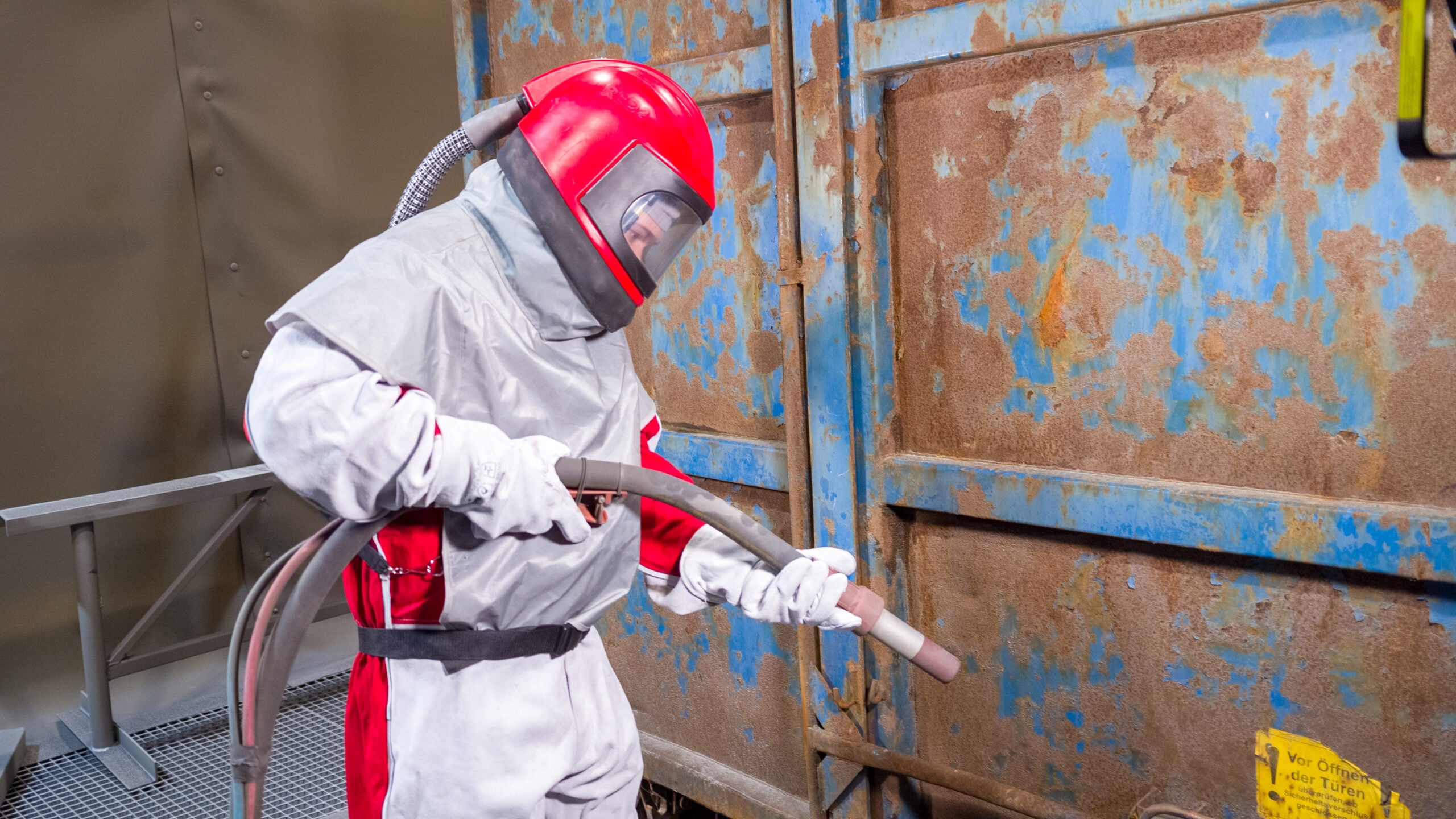
Mobile professional equipment straight from the manufacturer: from the small injector blaster to the 200-litre pressure blasting machine.
- since 1970Experience in blasting technology
- 0.1–12 barinfinitely adjustable blasting pressure
- TÜV & CEtested and certified
- ≈ 9,000jobs per year in the SAPI group
The complete range
Four machine families. The right technology for every task.
All dimensions from the current SAPI range. Prices and availability are in the shop, and for special requirements we are happy to advise you.

MAMMUT pressure blasting machine
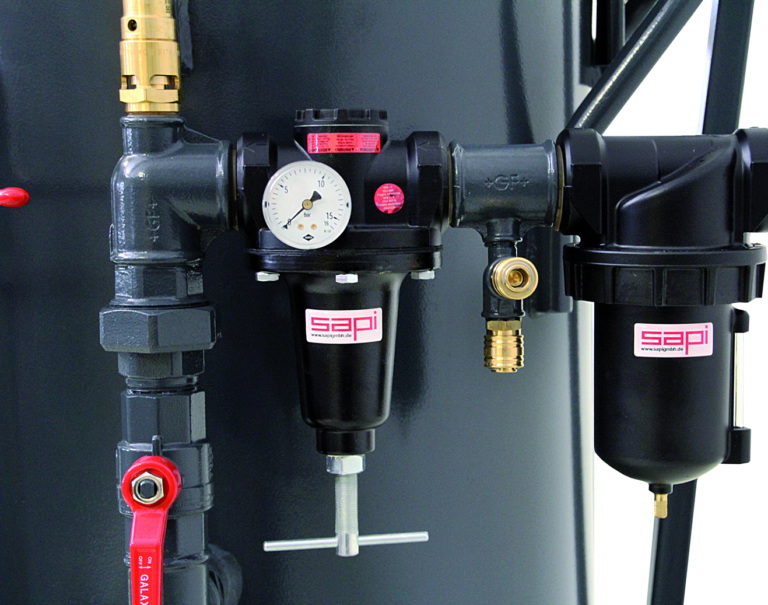
The workhorse: the pressure vessel drives the abrasive and air mixture through the hose at full force. For rust, coatings, concrete and large surfaces. Fixed piping, with pressure regulator, water separator and metering valve, optionally with QUICK STOP™ or inlet/outlet valve.

MAMMUT 100 L in a pallet cage
Everything pre-assembled in a standard pallet cage: MAMMUT 100 L with QUICK STOP™, 10 m blast hose with nozzle, breathing air filter and a storage box for protective equipment. Move it to site by forklift or crane, connect it and get started.
| Capacity | L × W × H | Weight | Shop |
|---|---|---|---|
| 100 L | 1,460 × 840 × 1,400 mm | approx. 260 kg | Price → |
PREMIUM low-pressure fine-blasting machine
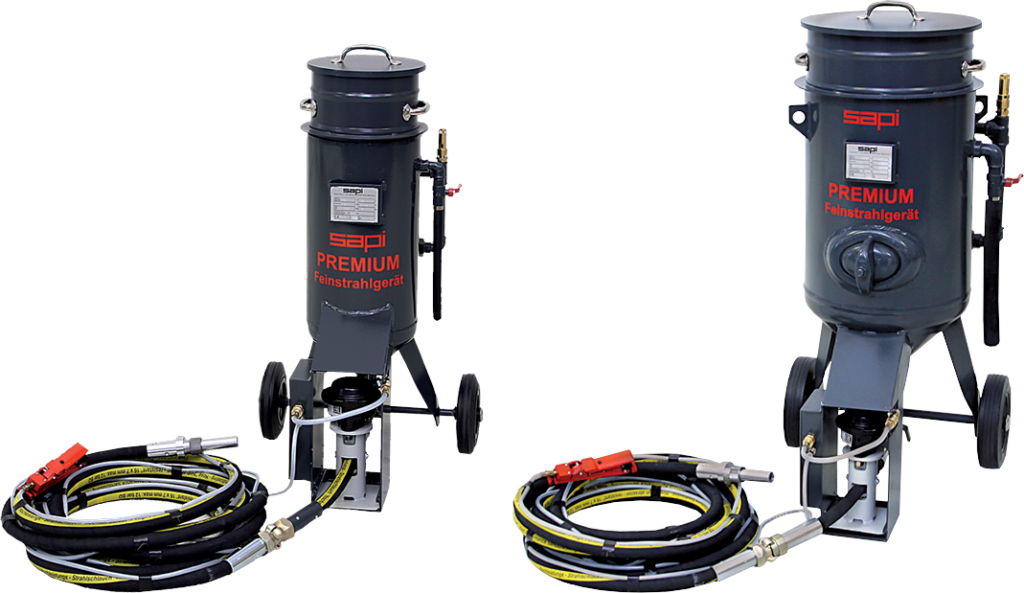
For everything delicate: classic-car panels, wood, stone, restoration. Pressure is finely adjustable and QUICK STOP™ is integrated. With Vario nozzle technology also as a swirl or flat jet and with water addition.

PROFI & PROFI TURBO
The affordable entry point that manages with an ordinary workshop compressor. For smaller blasting and touch-up jobs: the abrasive is drawn in by vacuum. With a boron carbide nozzle (service life up to 1,000 hours) for hobby and daily professional use. Not suitable for metallic abrasive.
Vacuum-recovery blasters PR 50 & DINO
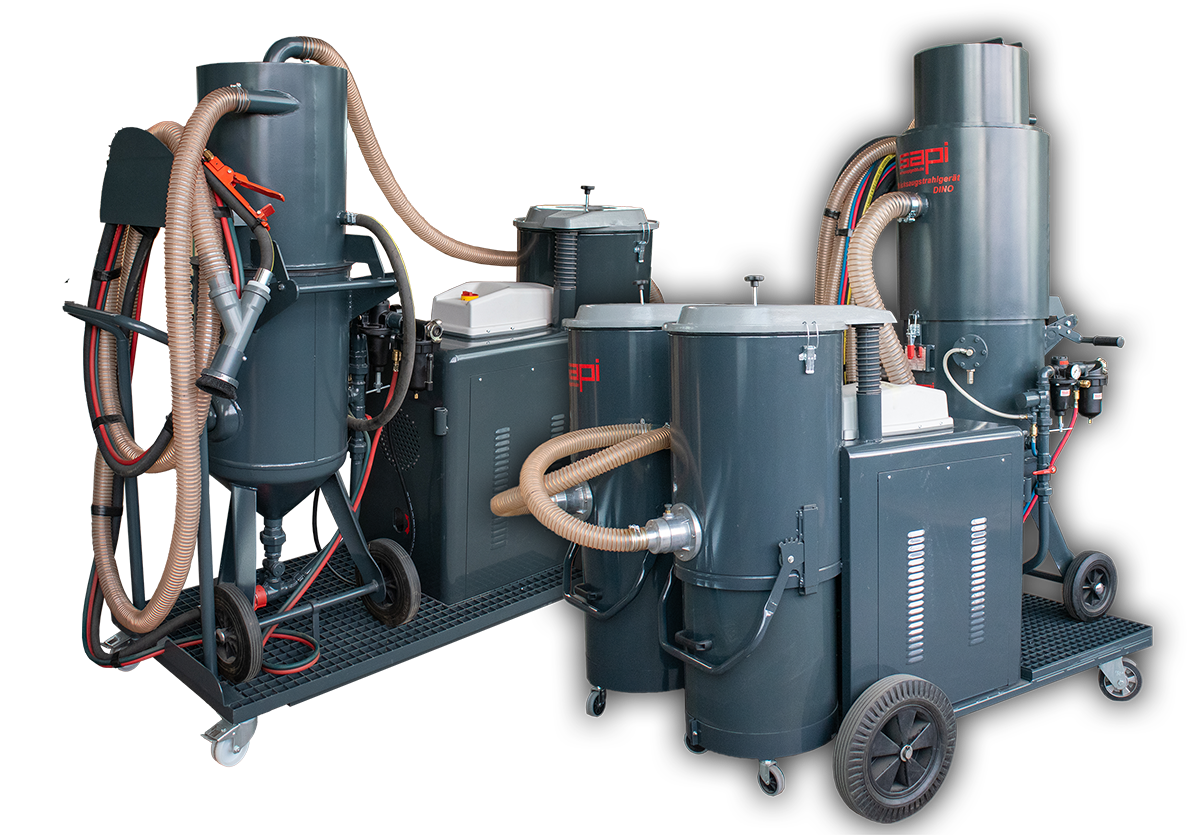
Blast in the workshop without masking or a dust cloud: a brush on the blast head seals against the surface, and abrasive and dust are extracted at once, filtered and reused. The PR 50 uses injector technology for welds and small areas, the DINO a pressure vessel for higher output. The DINO MASTER delivers 2 × 5.5 kW of extraction power and up to 20 m of blast hose.

Abrasive in a closed loop
PREMIUM 200 L with abrasive recycling
The complete system for anyone who blasts a lot: the abrasive is swept up, drawn from the hopper by the abrasive vacuum through the cyclone cleaner, dedusted and returned to the tank. You reuse it several times instead of disposing of it after one pass.
- 200 LBlast tank
- 5.5 kWAbrasive vacuum
- 70 LDust container
- 0.1–12 barBlasting pressure
Understand the technology
How does a sandblasting machine work?
Three methods, one difference: how the abrasive reaches the nozzle. Try it yourself: set pressure, abrasive flow and air, and see what happens inside the machine.
Simplified illustration: The animations only explain the working principle. They do not show the machines to scale, and the values and sequences displayed are not measured. The technical data of each machine is what counts.
- Blast
- Vessel
- Restart
Schematic illustration for explanation, not measured values.
SAPI pressure blasting machine: air on two paths
Downstream of the pressure regulator, the compressed air splits. One part flows into the side of the vessel and pressurises it. The other part runs as bypass air around the outside of the vessel to the T-piece, directly beneath the abrasive metering valve, and accelerates the abrasive there as well. You control blasting pressure, abrasive flow and bypass share independently of each other. That lets you match the machine precisely to the surface.
- CompressorSupplies the compressed air.
- Water separatorKeeps moisture out of the air so the abrasive does not clump.
- Pressure regulator with gaugeSets the blasting pressure continuously from 0.1 to 12 bar.
- Vessel airThe first air path: enters the vessel from the side and pressurises it.
- Pressure vessel with abrasiveThe rubber cone has a blunt, flat tapered end: pressure pushes it up from below into the filling opening and seals it. The screen and lid sit above it.
- Bypass air with air meteringThe second air path: you decide how much air flows past the vessel to the T-piece.
- Abrasive metering valveControls how much abrasive flows out of the vessel.
- T-pieceA simple pipe T: here the abrasive meets the bypass air and is accelerated.
- QUICK STOP™ Pinches the blast hose shut the moment you let go, in an emergency or when repositioning. The vessel stays pressurised and you carry on with no waiting. No abrasive run-on, up to 30 % less abrasive used.
- Deadman lever with control lineSits right at the nozzle. Pressing the lever starts blasting, and releasing it stops it at once. A safety flap prevents accidental activation.
- Blast nozzleAccelerates the mixture onto the surface.
Schematic illustration for explanation, not measured values.
Injector sandblasting machine: simple and economical
The hopper is not pressurised. The compressed air runs straight through the air nozzle into the blast head and creates suction in the mixing chamber. The blast hose enters the mixing chamber at an angle. This draws the abrasive in well and the air stream carries it along, which improves suction and output.
- CompressorInjector machines need 300 to 1,000 l/min, depending on the model.
- Air hoseCarries the compressed air straight into the blast head.
- Hopper (unpressurised)The abrasive sits in an open hopper, and a screen holds back coarse particles.
- Blast hoseSuction draws the abrasive in and leads it into the blast head at an angle.
- Deadman leverPressing the lever starts the air flow and with it the blasting. On release everything stops at once.
- Air nozzle and mixing chamberThe air nozzle accelerates the air, and in the mixing chamber it picks up the abrasive.
- Boron carbide blast nozzleService life of up to 1,000 hours, even with corundum. Blast nozzle and air nozzle are matched to each other.
Schematic illustration for explanation, not measured values.
PR 50 injector vacuum-recovery blaster: dust-free with cyclone and vacuum
The PR 50 works on the injector principle: the abrasive sits unpressurised in the silo. The blast gun rests on the surface with a dust-capture brush, and whatever rebounds is sucked straight back. The machine consists of three separable parts: silo, cyclone and vacuum. The cyclone does the separating: reusable abrasive falls through the screen back into the silo, while the TURBO vacuum draws off dust and dirt.
- Compressed airRuns through the handle straight into the blast gun. 400 to 800 l/min is enough.
- Silo (unpressurised)50 litres of supply. The container is not under pressure.
- Blast hoseSuction pulls the abrasive into the blast head.
- Blast gun with dust-capture brushTrigger in the hand, round brush on the surface. Brushes for flat surfaces and for inside and outside corners are available.
- Recovery hoseExtracts abrasive and dust right at the brush.
- Recovery cycloneA separate component between silo and vacuum, secured with clamps. This is where the abrasive separates from dust and dirt.
- ScreenA perforated disc at the bottom of the cyclone: it holds back coarse debris, and good abrasive falls into the silo below.
- TURBO vacuumIndustrial vacuum with polyester/cotton filter: draws dust and dirt out of the top of the cyclone.
- 230 V power connectionThe TURBO vacuum runs from a standard socket.
- Blast
- Vessel
- Rubber cone
- Extraction
- running, switched off separately
Schematic illustration for explanation, not measured values.
DINO pressure vacuum-recovery machine: pressure blasting without a dust cloud
The DINO blasts from the pressure vessel just like a normal pressure blasting machine. At the front of the nozzle there is also an attachment with brushes that seals the blast against the surface. Abrasive and dust are drawn into the cyclone on top of the vessel. Good abrasive collects there and, when you release the lever, falls back into the vessel as soon as the rubber cone drops. Dust and fines leave the top of the cyclone for the large 5.5 kW extraction unit. There a filter cartridge cleans the air and the dust falls into the container below.
- Compressed airPressurises the vessel and accelerates the abrasive.
- Pressure vesselConventional pressure blasting: 60 litres, 1 to 6 bar, from approx. 1,500 l/min.
- Blast hoseCarries the mixture from the vessel to the nozzle.
- Nozzle in PVC Y-pieceThe nozzle sits in the grey PVC Y-piece, with the round dust-capture brush at the front. The recovery hose connects at the angled branch.
- Recovery hoseSucks abrasive and dust back, including heavy metallic abrasives.
- Recovery cycloneSits on the vessel and returns good abrasive straight to the cycle.
- 5.5 kW extraction unitCreates the suction. The connection leaves from the top of the cyclone.
- Cartridge filter with shaker leverA filter cartridge cleans the air. Use the hand lever on top to shake the dust off.
- Dust containerSits beneath the filter and can be removed completely for emptying.
- Three-phase connectionThe extraction unit runs on 3 phases: 400 V, 50 Hz, 32 A CEE plug.
- Deadman leverPressing the lever starts blasting, and releasing it stops it at once.
- Inlet/outlet valveOn release the outlet opens and the pressure escapes downwards through the silencer, which dampens the noise. On pressing, it closes and the vessel builds pressure again.
- Rubber coneUnder pressure it seals the opening to the cyclone. Without pressure it drops, and the collected abrasive falls into the vessel.
| Pressure | Injector | Vacuum-recovery | Fine blasting | |
|---|---|---|---|---|
| Output | Very high | For lighter work | Medium, depending on machine | Finely adjustable |
| Air demand | From approx. 1,500 l/min | 300–1,000 l/min | 400–800 l/min (PR 50), from approx. 1,500 l/min (DINO) | From approx. 1,500 l/min |
| Dust | Open blasting | Open blasting | Extracted at the source | Open blasting, optionally with water |
| Ideal for | Large surfaces, rust, continuous use | Small jobs, touch-ups | Workshop, welds | Restoration, wood, stone |
| Models | MAMMUT 60–200 L | PROFI, PROFI TURBO | PR 50, DINO | PREMIUM 25–60 L |
SAPI QUICK STOP™
Lever released. Blast off. Pressure stays.
When you release the deadman lever, the QUICK STOP™ system pneumatically pinches the blast hose shut. The abrasive flow stops instantly, even if the nozzle is dropped. Because the vessel stays pressurised, it does not have to be vented and built up again.
With QUICK STOP™
- Lever released
- Hose is pinched shut
- Vessel stays pressurised
- Press lever: carry on at once
With inlet/outlet valve
- Lever released
- Vessel is vented
- Air is lost
- Rebuild pressure, then carry on
Most existing blasting machines can also be retrofitted.

What's inside the MAMMUT

- QUICK STOP™Safety shut-off with pneumatic hose pinching
- ChassisSturdy wheels for easy transport
- Metering valveControls the abrasive flow, suitable for all common abrasives
- Maintenance openingLarge handhole for easy access
- LidKeeps dirt and moisture away from the screen
- ScreenKeeps lumps, stones and packaging remnants out of the vessel
- Drain valveReleases the pressure, for example before refilling
- Pressure regulator & water separator0.1–12 bar, separates moisture from the compressed air
Compressor calculator
Which compressor for sandblasting?
Air demand depends on the nozzle and the vessel. Choose vessel size, nozzle and working pressure, and you will see the minimum delivery rate your compressor must achieve.
Machine
Compressor minimum
2,730 l/min
| Pressure | ø 3 | ø 4 | ø 5 | ø 6 | ø 7 | ø 8 | ø 10 | ø 12 |
|---|---|---|---|---|---|---|---|---|
| 4 bar | 1,500 | 1,500 | 1,500 | 1,500 | 1,700 | 2,220 | 3,470 | 5,150 |
| 5 bar | 1,500 | 1,500 | 1,500 | 1,500 | 2,050 | 2,680 | 4,180 | 6,020 |
| 6 bar | 1,500 | 1,500 | 1,500 | 1,760 | 2,400 | 3,140 | 4,900 | 7,060 |
| 7 bar | 1,500 | 1,500 | 1,500 | 2,000 | 2,730 | 3,560 | 5,560 | 8,010 |
| 8 bar | 1,500 | 1,500 | 1,560 | 2,250 | 3,070 | 4,010 | 6,260 | 9,020 |
| 9 bar | 1,500 | 1,500 | 1,750 | 2,500 | 3,410 | 4,450 | 6,950 | 10,010 |
| 10 bar | 1,500 | 1,500 | 1,930 | 2,750 | 3,750 | 4,900 | 7,650 | 11,010 |
Required delivery rate in l/min for the selected machine. Cells marked grey: here the vessel minimum sets the value, not the nozzle. Nozzle values from the SAPI air consumption table, for the actual pressure at the nozzle, with 10 m of blast hose of 16 mm internal diameter and a SAPI short nozzle. Plan in some reserve, as the nozzle wears in use. Values for 9 and 10 bar are calculated from this table.
Machine finder
Which sandblasting machine suits you?
Six questions, one clear recommendation. With reasons, a matching compressor and honest alternatives.
Applications
What do you want to uncover?

Steel and metal
Strip off rust, mill scale and old paint, as preparation for coating.
MAMMUT pressure blasting machine →
Vehicles
Strip bodywork and chassis, using fine-blasting technology depending on the panel.
PREMIUM fine-blasting machine →


Classic cars, wood and restoration
Gently remove old paint without damaging the surface.
PREMIUM fine-blasting machine →In action
See the machines at work
Fully equipped
Everything for your sandblasting machine
 NozzlesBoron carbide, silicon carbide, Vario
 Blast hosesIn all diameters, ready fitted
 Protective equipmentHelmets, suits, breathing air
 AbrasivesCorundum, slag, glass beads and more
Mobile isn't the answer for you?
Frequently asked questions
Buying a sandblasting machine: what you should know
What is the difference between an injector and a pressure blasting machine?
With an injector, the abrasive is drawn by vacuum from the unpressurised hopper and only mixed with the compressed air in the blast head. This is cheaper and manages with a smaller compressor, but delivers less output. With a pressure blasting machine, the vessel is pressurised, and adjustable bypass air additionally accelerates the abrasive directly after the abrasive metering valve. For large surfaces and blasting of more than 4 hours a day, we clearly recommend a pressure blasting machine.
Which compressor suits my sandblasting machine?
That depends on the machine and nozzle. Injector machines manage with 300 to 1,000 l/min, depending on the model. A pressure vessel needs at least around 1,500 l/min regardless of nozzle size. A MAMMUT with a 7 mm nozzle needs around 2,730 l/min at 7 bar, and with 8 mm around 3,560 l/min. The exact values for every combination are shown by the compressor calculator on this page.
How many litres should my sandblasting machine have?
The vessel determines how often you refill, not how powerfully the machine blasts. 60 litres is the most mobile at approx. 60 kg, 100 litres is the all-rounder, and 200 litres suits long blasting runs but weighs approx. 140 kg. Performance comes from the compressor and nozzle.
Which abrasive can I use?
That depends on the material, the surface and the result you want. All common abrasives can be used with our pressure blasting machines. For injector machines we advise against metallic abrasive because it is too heavy. For steel, slag or corundum are suitable, and for delicate surfaces glass beads or glass grit. More at Abrasives.
Can I use ordinary quartz sand for sandblasting?
We strongly advise against it. The quartz dust it produces can cause silicosis, a serious and incurable lung disease, and also endangers people nearby. In Germany and many other countries, blasting with sand containing quartz is therefore banned or heavily restricted. Quartz sand is also not very efficient. Use slag, corundum or glass beads instead.
Can I sandblast dust-free indoors?
Yes, with a vacuum-recovery blaster. The PR 50 is built for occasional work on smaller parts, welds and rust spots. The DINO series works with pressure, is faster and is suited, for example, to longer welds. More on dust-free machines.
Which sandblasting nozzle do I need?
Our customers mostly use a 7 mm boron carbide nozzle on pressure blasting machines and a 5 mm nozzle on injector machines. The right choice depends on compressor capacity, the abrasive, the surface you want and whether you blast dry or with water.
What additional equipment do I need?
You need a suitable compressor, blast hose and nozzle, abrasive, and protective equipment: blasting helmet with breathing air supply, blasting suit, blasting gloves and ear protection. Our quotations usually include a complete package.
What is SAPI QUICK STOP™?
A pneumatic safety shut-off with a deadman lever. As soon as the operator lets go, the blast hose is pinched shut and the abrasive flow stops. The vessel stays pressurised, which reduces air consumption and lets you carry on with no waiting. More about QUICK STOP™.
Are SAPI sandblasting machines safe?
Yes. Our pressure blasting machines are TÜV-tested with a certificate, CE-compliant and tested regularly. They are designed for a constant pressure of 12 bar.
How much does a sandblasting machine cost?
That depends on the technology and size: injector machines are the lowest-cost class, while pressure blasting machines and vacuum-recovery machines are clearly higher. You will find current prices in the SAPI shop. For complete packages we will gladly prepare a quotation for you.
The MAMMUT catalogue to take with you
All machines, nozzles, hoses and technical data in one PDF.